Showing posts with label Europe. Show all posts

Wednesday, June 6, 2012

PANETTA @ SHANGRI-LA DIALOGUE: EXPLAINING US' ASIA PIVOT

On June 2, US Secretary of Defense Leon Panetta delivered a keynote address at the IISS's Shangri-La Dialogue in which he outlined in greater depth more specific elements concerning the US's shift toward Asia-Pacific, fleshing out the context, driving principles, and physical and material investments to which the US is committing over the next several years, beginning now.

The overall context is one of constraints - namely economic - and of course the need to adapt to the profound changes underway caused by the emergence of Asia Pacific as a major global pole. The official line is to accomplish more with less, and to act more effectively within a series of defined limits and fixed objectives.

Most of the speech, however, was spent elaborating the four underlying principles and going into details about what the policy consequences would be. 

What are the four basic principles outlined by Panetta?

More after the jump...

Friday, May 18, 2012

SPOTLIGHT ON...: NEW FRENCH ADMINISTRATION (FABIUS, LE DRIAN, MOSCOVICI)

The government of French President François Hollande, led by Prime Minister Jean-Marc Ayrault, took office yesterday, on May 17.  Among the 34 ministers in Hollande's cabinet (of which half are women), three people in particular are likely to be especially visible to international audiences. They are Foreign Affairs minister Laurent Fabius, Defense Minister Jean-Yves Le Drian, and Finance Minister Pierre Moscovici.

Potusphere takes a quick glimpse at these men and their careers so far.


LAURENT FABIUS: FOREIGN AFFAIRS

Fabius, 65 years old, is one of the few "elephants" (familiar term to describe top Socialist Party leaders) to find a place in the new French government. He was previously Minister of Finance (2000-2002), Industry and Research (1983-84), and Budget (1981-83). From 1984-1986, Fabius served as France's youngest prime minister (just 37 years old) under another Socialist president, François Mitterand. 

Laurent Fabius was also twice president of the National Assembly (equivalent of Speaker of the House) from 1997-2000 and 1988-1992, serving from 1995-97 as the president of the parliament's socialist group (leader of the opposition) when the Right won the majority.

In the 1980s, Fabius successfully campaigned for French sanctions against the South African apartheid regime, publicly pushed back against communist Poland, and decried Castro's Cuba. But Fabius is most known for his vocal opposition to the European Constitution Treaty in 2005, which ran contrary to the position France's and Europe's socialists, who lined up in support of the treaty. Fabius presided over other key moments in Europe - namely the passage to the euro and the creation of the major French energy conglomerate Areva. On assuming his foreign affairs post on May 17, Fabius said: "I am profoundly European, but we need a different Europe, one that is more oriented toward jobs."

In 2009, Fabius expressed his opposition to France's reintegration into NATO's integrated command.

Fabius was a rival of François Hollande within the Socialist party, ran against him in the Socialist presidential primary before supporting party secretary Martine Aubry's bid. Once Hollande was elected the party's candidate, Fabius lent his support and expertise to Hollande - traveling abroad on the candidate's behalf and mapping out the new president's first 100 days in office. Fabius was named foreign affairs minister not for his proximity to the candidate but rather for his experience, expertise, and gravitas. The nomination is also viewed by some as an effort by President Hollande to represent the different currents of his party within his administration.


JEAN-YVES LE DRIAN: DEFENSE

Le Drian, 64 years old, is a longtime friend of François Hollande and early supporter of his presidential campaign. He is from a modest family in Brittany, from a town (Lorient) with close historical ties to the French military. He first registered with the Socialist Party after hearing François Mitterand speak and entered politics at the local level in 1977 before being elected to the National Assembly just one year later at the age of 30. Le Drian spent much of his political career connected to Brittany (serving as mayor of his hometown, member of parliament representing that area). From 1991-92, Le Drian was the secrétaire d'Etat à la mer, a ministerial post overseeing, in part, coastal and sea affairs. Most recently, he was the president of the Brittany region (a job perhaps equivalent to a US governorship).

Once in 2007 and again in 2009, former president Nicolas Sarkozy proposed the helm of the defense ministry to Le Drian, who twice refused on the grounds that he did not want to serve in a government that was not Socialist. 

Since 2006, he animated a high-level monthly defense and security reflection group comprised of military officials, civil servants, industry representatives and former Socialist ministers of defense. 

During the 2012 presidential campaign, Le Drian was in charge of defense and security questions for François Hollande. It is believed that Le Drian's friendship with the head of the French army will be an advantage. 

Le Drian visited Washington once during the campaign, in March 2012.


PIERRE MOSCOVICI: FINANCE

Pierre Moscovici, now 54 years old, was the youngest person to be elected Socialist Party secretary (at just 33 years old in 1990). In 1992, he became Party treasurer.  Moscovici held other leadership roles within his party while becoming close to former prime minister Lionel Jospin. 

Moscovici was first elected to European Parliament in 1994, where he served until 1997 before becoming France's Minister of European Affairs (1997-2002). During his time as Minister, Moscovici helped to prepare France's EU presidency (beginning of 2001), helped to negotiate the European Constitution Treaty.  

In 2004, Moscovici was once again elected a member of European Parliament, where he served until 2007 and during which time he served as one of its vice presidents. In 2007, he returned to the French National Assembly. 

Considered to be a leading figure in the Socialist party's social-democrat current, Moscovici was an early supporter of François Hollande's presidential bid and served as Hollande's campaign director.


(Photo credits: Manche Libre; France Inter; AFP, respectively)

Monday, May 14, 2012

AMERICA'S DOMESTIC POLITICS AND ITS PLACE IN THE WORLD (EGEA BLOG)

Recently, I had the opportunity to participate in an interview with Olivier Kempf for his EGEA blog, during which I responded to questions on America's internal and external politics ranging from - the enduring impact of America's founding values; the importance of the economy on Washington's policies; the potential consequences of internal generational shifts; the place (or not) for consensus in the American political debate; and a look at where transatlantic relations may be headed.

Please click here to read the interview (in French) on EGEA. An English translation of the interview will be published shortly on this site.


Monday, March 5, 2012

OBAMA @ AIPAC / McCAIN ON SYRIA

On March 4, President Obama delivered remarks before the annual AIPAC conference held in Washington. Obama and Israeli Prime Minister Netanyahu met behind closed doors in the Oval Office today.

Obama's speech reaffirmed America's - and his own - solidarity with Israel, Israel's right to sovereign action, and lamented the excessive "loose talk of war." Calling for more time to let sanctions work (citing Europe's new round of sanctions set to take effect in July 2012), Obama highlighted his administration's effort to build an international coalition to place diplomatic, political, and economic pressure on Iran.

While reassuring Israeli leaders that his policy was not one of containment, Obama argued that it is important for Iran to decide its own fate, citing examples of countries that independently renounce nuclear without a motivating military imperative...

While Obama was busy trying to calm rising tensions over the possibility of an Israeli attack on Iran - in part citing Iran's growing regional unpopularity and the diminishing influence of Tehran and its ally Syria - Senator John McCain took the Senate floor and called on the US to lead an international effort to bomb Syria and precipitate the fall of Bashar al Assad's regime.

Although the administration has used strong language to condemn the violence and call for Assad to step down, it has opted for prudence regarding the arming of the opposition forces. Absent a clear understanding of who the opposition are, what they want, and how they hope to achieve it, the administration has chosen caution - caution to avoid sparking a civil war, the use of chemical weapons, or a regional arms race.

On the other hand, American conservatives have long called for action to arm the opposition and put an end to the bloodshed. McCain's comments today represent the first time an American leader has publicly advocated US-led bombing.

Read both mens' remarks here:
President Obama's 2012 AIPAC Address
Senator John McCain's Remarks on Syria on the Senate Floor

Friday, February 24, 2012

SLAUGHTER'S PATH AHEAD IN SYRIA

In light of today's meeting in Tunis of the Friends of Syria, Anne-Marie Slaughter (former director of policy planning at the State Department and current professor at Princeton) has published an editorial in the New York Times proposing a plan of action to end the violence in Syria.

Slaughter advocates foreign military intervention. Simply arming the opposition forces would, in her opinion, create conditions for a larger regional proxy war that could open the door to an Al Qaeda presence in Syria and access to biological and chemical weapons.

Instead, she proposes the creation of "no-kill zones" near the Turkish, Lebanese and Jordanian borders managed by "already active cilian committees"; no-kill zones that would serve as "short humanitarian corridors" to allow for the passage of food and medical supplies as well as wounded patients.

In Slaughter's words, "these zones would require nations like Turkey, Qatar, Saudi Arabia and Jordan to arm the opposition soldiers with anti-tank, countersniper and portable antiaircraft weapons" to be used defensively in order to stop attacks by Syrian military or other government forces. The aforementioned countries, and even European nations like France and Great Britain, could be called on to provide tactical and strategic advice.

Finally, Slaughter calls on Turkey and the Arab League to take a more active role in aiding Syrian opposition forces and insists that the international community should take no action "without the approval and the invitation of the countries in the region."

For Anne-Marie Slaughter, "The international community can draw on the power of nonviolence and create zones of peace." To honor the sacrifices of the Syrians thus far, the international community must provide them with the tools and means to overtake Assad.

How to Halt the Butchery in Syria, Anne-Marie Slaughter (New York Times)

(photo credit: state.gov)

Thursday, January 5, 2012

OBAMA ON THE DEFENSE STRATEGIC REVIEW

Earlier today, President Obama introduced the findings of the Defense Strategic Review, designed to outline both American strategic interests and its spending priorities over the coming decade while cutting hundreds of billions of dollars from the defense budget. The DSR is set to flesh out approximately $500 billion in cuts, with the potential to add another $500 billion in reductions beginning in January 2013.

The President was Joined by Defense Secretary Leon Panetta and the chairman of the Joint Chiefs, General Martin Dempsey.

The President gave no specific figures nor did he announce the funding of any new initiatives or weapons systems. While outlining the overarching priorities going forward, Obama added that US might should be defined more comprehensively - including by its agility, flexibility, leanness, and preparedness for new challenges.

Some important take away points from the President's speech:

- Key commitments will remain: "vigilance" in the Middle East, maintained investment in NATO, strengthened presence in Asia Pacific.

- Replacement of large nation-building missions (Iraq, Afghanistan) with the reliance on smaller conventional forces coupled with the modernization of systems and capabilities reflecting future threats rather than outdated Cold War paradigms. This means funding programs geared toward intelligence, surveillance and reconnaissance, counterterrorism efforts, countering weapons of mass destruction, and gaining access to denied spaces.

- Amelioration of treatment given to veterans, opening opportunities to better health and mental health care, job opportunities, and integration back into society following their service.

- Emphasis on the need to rebalance the ensemble of national programs, restore America's internal resources and infrastructures, and begin to climb out of its massive debt - defense budget cuts are a major first step in achieving this balance.

None of these points were particularly surprising, as administration officials have been talking for weeks about these same themes, including the will to bolster American presence in Asia while scaling back the large missions that so thoroughly consumed the military since 9/11.

A number of questions remain as to what the specific cuts will look like and how they will be received and debated both within the US (and among Republican presidential candidates) and among America's allies:

For example, what will be the general reaction in Europe as the US shifts its focus to Asia Pacific? Will there be any notable change in troop numbers? What new expectations might the US have of its NATO allies given its turn to other areas of the world? What are possible areas of convergence for the US and Europe in emerging power zones? What challenges can be anticipated in the transatlantic alliance following this strategic shift?

More precise details of the Defense Strategic Review will follow in the coming weeks.

Stay tuned to Potusphere for the latest in these developments...

- Amy Greene

Wednesday, July 13, 2011

REACTION TO CLINTON'S MAJOR EUROPEAN SECURITY ADDRESS (IRSEM)


Following Secretary of State Clinton's January 2010 speech on European security before the Ecole Militaire at the French Defense Ministry, I published an analysis of her remarks for the March 2010 Lettre de l'IRSEM, which is the monthly publication of IRSEM, a think tank housed in the Ecole Militaire.

That analysis can be found at the IRSEM website by clicking this text.
- Amy Greene

(photo credit: Department of State)

Tuesday, July 12, 2011

AMERICAN POLITICAL PERSPECTIVES ON MIDDLE EAST PEACE (LCI)

Last evening, July 11, I was a guest on Le 17/20 on French news channel, LCI. The panel was intended to focus on yesterday's meeting of the Middle East Quartet in Washington DC, but evolved into a discussion primarily about Israeli and Palestinian internal politics.

I contributed an analysis of the American political landscape with the following reflections:

--How strong is Obama's political will to press this issue? Currently on his plate: consuming debt negotiations and the early stages of the 2012 electoral cycle. Israel's defense and security is a US domestic electoral issue. Even if Obama were willing to take a harder line to transform his May 2011 speech into action, this would necessarily involve increased pressure on Israel and opening himself (and his campaign) to avid criticism from across the two-party spectrum, including from representatives protecting their own seats in their home districts.

--A closer look at US domestic opposition to the Palestinian vote this September: I signaled the resolution proposed by Reps. Cantor (R-VA) and Hoyer (D-MD), which passed the House almost unanimously (407-6), and threatens to suspend aid to Palestine if they proceed with the UN vote this September and advance toward a deal with Hamas.

--The US's inability to translate words to action: Again, no progress to speak of following Obama's speech; the loss of a widely-respected envoy (Mitchell) who failed to invest the two parties in productive dialogue; a replacement for Mitchell, David Hale, who has barely been visible on the issue; and an American administration very reticent to convene the Quartet out of almost total disbelief that it could produce any effective course of action heading into the summer.

--I suggested that Washington's paradoxical objectives (protection of Israel while maintaining access to Arab oil supplies) can often create an obstacle to developing a coherent policy in the region.

- Amy Greene

Sunday, April 24, 2011

AMERICA'S NEW FOREIGN POLICY AGENDA: LESSONS FOR EUROPE (IRSEM)

Appearing in the most recent installment of La Lettre de l'IRSEM is an article I wrote assessing the current and coming priorities in US foreign policy as well as a few possible areas for increased transatlantic cooperation.

The succinct policy brief highlights:

- Current realities and priorities in US foreign policy
- World views of the Democratic and Republican parties
- Areas for closer EU-US cooperation and strategic development
Click here to read the article online at the IRSEM (Institut de Recherche Stratégique de l'Ecole Militaire) website.

Or Click Here to download the article in PDF format.


- Amy Greene

Tuesday, March 8, 2011

ALEXANDER LENNON: THE US IN A NEW GLOBAL SECURITY ORDER

Editor-in-Chief of The Washington Quarterly and Senior Fellow at CSIS, Alexander Lennon, spoke in Paris to offer his prognostic about Obama's approach to the emerging global security order during the second half of his administration.
The US will shift from action to reaction during these next two years as it necessarily reflects on how to adapt the major pillars of American foreign policy as the 3 pillars of the post-Cold War global security order are called evermore into question.

1. Expansion of free markets: The global financial crisis demonstrated the fallibility of a Western-led internet-based market economy. China's model characterized by capital controls and managed exchange rates (and managing this is the true "China Challenge") has been an example for other emerging markets.

2. Spread of democracy: The US-led invasion of Iraq cast many doubts - should the US have been there at all? Was the violence justified given the outcome? Is democracy appropriate for nations with no history of this governance? - a question that will be played out in the Arab revolutions' second acts.

3. Peace (use of force in self-defense): Following 9/11, the US undermined this pillar by balking at international legal norms governing the use of force in the premise of its Iraq invasion.

A highlight of the event came in Lennon's response to an audience question about the failure of engagement with Iran. For Lennon, engagement is a means to an end rather than the end itself; therefore, engaging "hostile" countries can increase pressure rather than meaningful integration. Toughening sanctions coupled with ongoing talks can be very effective parallel tracks, especially as indecipherable internal domestic battles play out within, and shape the changing stances of, your adversary.

- Amy Greene

(photo credit: CSIS)

Tuesday, October 19, 2010

IVO DAALDER IN PARIS: EU/NATO COORDINATION KEY

In an appearance at the Ecole Militaire organised by the Fondation pour la Recherche Stratégique and the IRSEM, and timely given his op-ed in today’s Herald Tribune pleading for better EU/NATO coordination, Ivo Daalder spoke about the Alliance leading up to Lisbon and relayed its two main goals:

1. Revitalize NATO for 21st Century realities, and
2. Poise ISAF for success by increasing the number of trainers on the ground.

In a brief, formulaic speech, Daalder developed the metaphor of NATO as a house (foundation: core values, walls: collective defense and cooperative security, roof: common technical capabilities sharing), while praising the consultative analysis that defines the Alliance's internal deliberations and advocating for increased investment in new technologies.

Daalder urged member states to maintain NATO funding levels despite the crisis, arguing it cheaper to spend collectively rather than individually or even bilaterally. As nations tighten their belts, collective projects like NATO deliver a better return on investment for the money spent, which in turn obliges NATO to better-manage its resources, rather than depend on a budget increase, to maximize efficiency in times of austerity.

Daalder took firmer stances in the Q&A, notably on the debilitating lack of coordination between EU and NATO (also the topic of today’s IHT op-ed). The major points:

- Russia: The consensus to reengage is real within NATO, and it is now up to Moscow to set the tone for further cooperation.

- Global NATO: Daalder revised his former position to echo comments made by Secretary Clinton during the Q&A following her January 2010 speech on European security at the IRSEM. NATO is a regional organization called to act globally and should not aspire to become a global policeman capable of supplanting the UN. Rather, establishing cross-regional partnerships is the key to bolstering NATO’s effectiveness beyond its neighborhood without drastically rethinking its current membership.

- EU/NATO: Daalder's harshest criticism and most vehement comments were reserved for this topic. With inefficient inter-agency organization with little interaction but at the highest levels (Rasmussen/Ashton), the NATO/EU relationship is marked by what it lacks: no common capabilities, no coordination, and incredible lack of communication between the two. For Daalder, the US does not care which of the two takes the lead – the key is that they talk and decide who heads which dossier – but rather decries the waste generated by having two parallel, uncoordinated (often overlapping) tracks of action on every dossier.

Little mention was made of Afghanistan, though Daalder acknowledged the “significant increase” of EU resources devoted to that mission and the fact that Europe bears the loss of life in equal measure to the United States.

To read Daalder’s piece on the EU/NATO relationship, published in the International Herald Tribune: LINK

- Amy Greene

(photo credit: US Department of State)

Friday, January 29, 2010

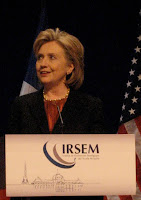
HILLARY CLINTON IN PARIS: MAJOR ADDRESS ON EUROPEAN SECURITY


This afternoon, January 29, Secretary Clinton delivered a major address on European Security in conjunction with the US Embassy and IRSEM, the Ministry of Defense's strategic studies think tank (Institut de Recherche Stratégique de l'Ecole Militaire).

While emphasizing the need for collective European-American responses to delicately interlaced global challenges, Clinton voiced her support for the Lisbon Treaty, Europe's decision-making autonomy, and praised Europe as a model of transformative power. Though she did mention areas for improvement (need for democratization in certain zones, increased economic opportunity, revamped arms control regime and updated EU/North American institutions fit to manage new problems) and new frontiers for collaboration (cyberterror, terrorism, climate change, energy security).

While assuring the audience that the US's security is anchored in Europe ("Much of what we hope to achieve globally depends on our European partners") based largely on shared, universal values, Clinton asserted the six core principles guiding America's views on European security:

1. Sovereignty of All States to choose allies, provide for their defense, and define boundaries while rejecting claims to spheres of influence.

2. Indivisibility of European Security - there is one Europe with the US as its partner, and sometimes Russia too. It is time to move beyond false divisions (ie: NATO v. non-NATO, EU v; non-EU, etc.) in order to meet common goals.

3. Unwavering Commitment to Article V of NATO - the US will use missile defense to protect all NATO territory. The US is working to engage Moscow to convince it of the stake Russia holds in the presence of nearby missile defense.

4. Practicing Transparency in Dealing with Europe - global threats demand more open exchanges between militaries (info, exercises, site visits). The US supports a revived CFE Treaty for a modern security framework that limits deployment, reinforces territorial integrity, and meets new challenges.

5. Commitment to Non-Proliferation through support of existing treaties, negotiation of new nuclear posture, press other nations to reduce their arsenals and secure stocks.

6. Support Democratization Efforts in order to nourish free expression, encourage development, and end abuses like human trafficking. In this context, the US strongly supports strengthening the OSCE.

Other central topics raised by Clinton:
- Russia: engagement to meet challenges like Iran, climate change, energy security, and non-proliferation.
- China: use a mix of existing institutions to work with Beijing. Key elements: promote military transparency, convince them to sanction Iran, include them in strategic moves like the North Korea talks
- NATO Enlargement: Clinton voiced support for ongoing NATO enlargement plans with Eastern European nations. When this author asked about including non-Western nations who meet membership criteria, Clinton opposed stretching NATO's geography but cited NATO/ISAF as an example of successful cross-hemisphere cooperation that could be applied to other issues like cyberterror.

Click HERE for full text, taken from the State Department.

- Amy Greene

Tuesday, December 1, 2009

SPOTLIGHT ON...: IAN KELLY, US REPRESENTATIVE TO THE OSCE


Pending confirmation by the US Senate, current State Department spokesman Ian Kelly will move to Vienna as the US's representative to the Organization for Security and Cooperation with the rank of ambassador.

Kelly has significant knowledge of Europe and a regional expertise in Eastern Europe/Russia. The State Department spokesman since May 2009, Kelly spent the first months of the Obama administration as deputy assistant secretary for European and Eurasian Affairs. From 2007-2009, he was director of the Office of Russian Affairs overseeing Russia, Ukraine, Moldova, and Belarus. From 2004-2007, he spent time at the US Mission to NATO as a public affairs counselor.

During the Clinton administration, Kelly was the State Department's Director of Democratic Initiatives to the Newly Independent States during which time he helped to coordinate democracy-building efforts in both former Soviet republics and in Russia.

-Amy Greene

Wednesday, November 25, 2009

THE NEW AMERICAN ARROGANCE? ALLIES' FRUSTRATION OVER OBAMA'S APPROACH

In an op-ed in yesterday's New York Times, Maureen Dowd writes that the firing of White House Counsel Greg Craig, a political death caused by "a thousand leaks," "sent a chill through some Obama supporters" who saw this as the most disgraceful moment in his young presidency. Recalling Obama’s decision not to help Caroline Kennedy in her quest to replace Hillary Clinton in the Senate after all she did to support his candidacy, Dowd notes that "many donors and passionate supporters are let down by Obama’s detachment, puzzled at his failure to make them feel invested when he’s certain to come back to tap their well soon enough."

This assessment holds true, too, in the foreign policy realm.

Secretary Clinton's trip to the Middle East uncovered the bankruptcy of America’s strategy while also exposing its unwillingness to challenge Jerusalem's violation of its roadmap obligations. The US's equivocal response sent a message – to rising powers, that there is as of yet no real price to challenging the US; to smaller powers, that America will defer to a so-called bigger power, even when the big power's aggressions force others to bear the costs.

In Europe, where Obamania is at its most fervent, many sense that the president dispatches others to drum up increased support (money/troops for Afghanistan, etc.) but treats the continent's leaders with contempt, disdain, or indifference. There are a growing number of signals that Obama dismisses Europe but for when it is expedient not to. Obama’s dealings with President Sarkozy are tense, despite the French president’s concerted effort to move closer to the US including through French reintegration into NATO's Central Command. Otherwise, Obama refused five times (before accepting) to meet PM Brown at the G20 summit in Pittsburgh, sent Secretary Clinton to the Berlin Wall commemorations in November, and recently charged Vice President Biden with a European delegation dinner held at the White House even though Obama was in town.

Beyond Europe, similar resentments are emerging. In Eastern and Central Europe, in Asia, smaller nations in the shadows of rising or resurgent powers have aligned with America and depend on the security and economic guarantee the alliance offers. These countries worry that US rapprochement with big powers comes without any counter-demands, that its willingness to dialogue with anyone reveals few strongly-developed bedrock stances, and that its failure (or impotence) to assert itself against North Korean, Iranian, or even Israeli aggression does not bode well for future dust-ups. They perceive an exceedingly conciliatory America and fear an impending dilemma – choosing between Washington and Beijing, or Moscow, etc. – a decision that has less to do with choice, and more about the lack of it.

Obama may be the most popular guy in school, but he cannot stay that way without the support of his peers. American allies want Obama to succeed without being cast aside in a flurry of gestures designed to placate former adversaries or to avoid sparking any new tensions. Among the dangers of Obama's approach is the threat of a new American arrogance. Instead of taking its basis in the Bush-era belief in the superiority of America's values, it risks to be the result of a leader's inflated sense of personal importance and entitlement to unwavering ally support. Should Obama believe too deeply in his cult of personality and travel the world asking always for more without giving the necessary reassurances, he risks disappointing America's most steadfast partners once again - this time, the culprit will not be a president seen to have little regard for global opinion as was the case with Bush. Rather, Obama would undermine true solidarity by breaking with the very premise of his election - a return to respectful dialogue and cooperation not only with adversaries, but with all.

-Amy Greene